



Key summary
Titanium has a high strength-to-weight ratio and is corrosion resistant, biocompatible and heat resistant. It is around 40% lighter than steel with comparable strength, and it resists saltwater and many chemicals. It comes as commercially pure grades or alloys:
-
Grade 1 (commercially pure): highest formability
-
Grade 2 (commercially pure): general-purpose use
-
Grade 5 (Ti-6Al-4V): the standard high-strength alloy
-
Grade 23 (Ti-6Al-4V ELI): load-bearing medical implants
Typical applications include aerospace structures and engines, medical and dental implants, marine and chemical-processing equipment, and high-performance automotive parts. You can make titanium parts in two main ways:
-
CNC machining: suits tight tolerances and fine surface finishes. Titanium's low thermal conductivity keeps heat at the cutting edge, so machining is slower and wears tools faster than aluminum or steel.
-
Metal 3D printing (DMLS): suits complex and topology-optimized geometries.
This guide covers titanium's key properties, compares its main grades, outlines typical applications and explains the trade-offs between manufacturing processes.

Titanium properties and uses
Titanium is the metal engineers choose when a part must be strong, light, and able to survive harsh environments. It has one of the best strength-to-weight ratios of any metal, around 40 percent lighter than steel while nearly as strong, plus excellent corrosion resistance and biocompatibility.
Titanium comes in commercially pure grades (1 and 2) and alloys (Grade 5/Ti-6Al-4V, Grade 23), and is used in aerospace, medical implants, and marine and chemical hardware. It can be machined or 3D printed, though its low thermal conductivity makes machining slower and harder on tools. The trade-off is cost: titanium is more expensive than aluminum or steel to buy and to process.
What is titanium? Titanium is a metal engineers reach for when a component has to be strong, light and able to survive harsh environments at the same time. It has one of the best strength-to-weight ratios of any metal. Titanium is around 40 percent lighter than steel, while only about 5% less strong. Add excellent corrosion resistance and biocompatibility, and you have a material that shows up in jet engines, medical implants and deep-sea hardware alike. Titanium costs more than aluminum or steel, both as raw stock and to machine as it is harder on cutting tools and slower to process.
Key properties of titanium
-
Strength-to-weight ratio: Titanium gives you close to steel-level strength at roughly half to two-thirds of the weight. Titanium has a tensile strength of about 900 to 950 megapascals, at a density of only 4.43 grams per cubic centimeter.
-
Corrosion resistance: Titanium has a thin, stable oxide layer the moment it meets air or water. That layer protects it against saltwater, chlorine and most chemicals, which is why it can last in marine and chemical-processing environments where steel would rust.
-
Biocompatibility: Titanium forms a protective oxide layer that makes the body not react to the metal. Tissue and bone accept it rather than reject it. Bone bonds directly to it, so it is a standard choice for implants and dental work.
-
Heat resistance. Titanium keeps its strength at temperatures that would weaken aluminum. Some titanium stays usable up to around 400 degrees Celsius.
-
Low thermal conductivity. Titanium does not shed heat quickly. This is useful in some applications, but it is also why titanium needs a careful machining approach. Heat builds up at the cutting edge instead of flowing away.
One property to design around is stiffness. Titanium's modulus of elasticity is roughly half that of steel, so a titanium part flexes more under the same load. For stiffness-critical parts you often need a slightly heavier cross-section to compensate.
Common titanium grades
Titanium comes in commercially pure grades and in alloys. Four grades cover most manufacturing work, and Protolabs Network offers titanium in Grade 1, Grade 2 and Grade 5 for titanium CNC machining.
-
Grade 1 is the softest and most ductile commercially pure titanium. It forms easily and resists corrosion well, which makes it suitable for parts that need shaping rather than raw strength.
-
Grade 2 is the most widely used commercially pure titanium. It is stronger than Grade 1 but still machines and welds well. This makes it a common choice for chemical and marine parts.
-
Grade 5 titanium, also called Ti-6Al-4V, is the workhorse alloy. It contains 6% aluminum and 4% vanadium, and accounts for roughly half of all of the titanium used worldwide. It is far stronger than the pure grades and is heat-treatable, which is why it dominates the aerospace sector and medical work.
-
Grade 23 is a purer version of Grade 5 titanium, with lower impurities for extra toughness. It is the grade used for load-bearing medical implants.
The rule of thumb: choose a commercially pure titanium when corrosion resistance and formability matter most, and Grade 5 titanium when you need strength.
What is titanium used for?
Titanium earns its cost in applications where failure is expensive and lightweight, corrosion resistance or biocompatibility are critical.
In aerospace, titanium appears in airframe structures, engine discs, brackets and fasteners, where every gram saved improves fuel efficiency. In medical work, its biocompatibility makes it the standard for hip and knee implants, bone screws and dental implants.
Marine and chemical industries use titanium for pumps, valves and heat exchangers that are used in seawater or with aggressive chemicals. In motorsport and high-performance automotive, titanium turns up in connecting rods, valves and exhaust components where strength-to-weight is worth the price.
The common thread is that titanium is rarely the lowest-cost material, but it is often selected when no alternative can provide the required combination of strength, low weight, corrosion resistance, and biocompatibility.
Manufacturing titanium parts: machining and 3D printing
Titanium is most commonly CNC machined, but it is also well suited to metal 3D printing.
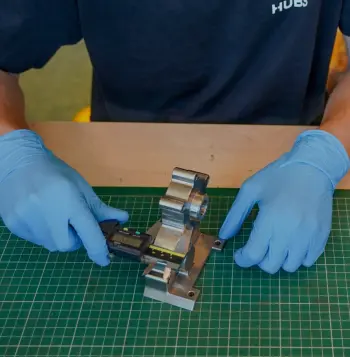
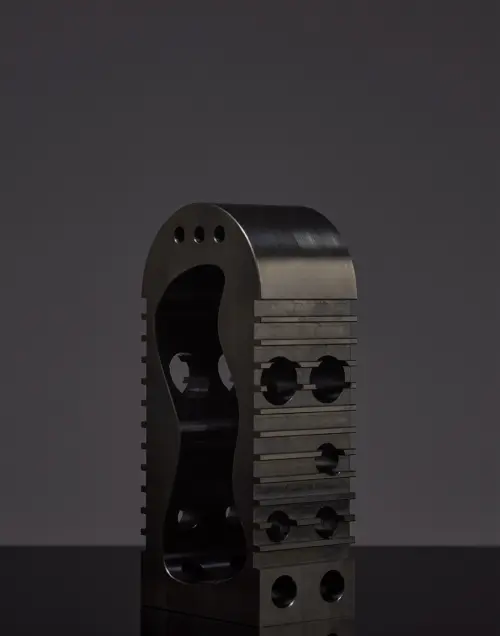
CNC machining removes material from a solid titanium block with cutting tools and gives you the tightest tolerances and best surface finish. The biggest challenge is titanium's low thermal conductivity: heat concentrates at the cutting edge, which wears tools quickly.
In practice, this means sharp carbide tooling, lower cutting speeds, high feed rates and plenty of coolant. It is achievable, but slower and more tool-intensive than machining aluminum, which is reflected in cost and lead time. The tolerances of titanium parts depend on the specific process and geometries rather than as a result of a single fixed figure.
Metal 3D printing, typically Direct Metal Laser Sintering (DMLS), builds titanium parts layer by layer from powder. This suits complex geometries, internal channels and topology-optimized shapes that would be hard or wasteful to machine.
For a bracket with organic curves or lattice structures, printing often makes more sense than cutting it from solid stock.
A practical pattern is to combine the two: 3D print a complex body, then CNC machine the faces that need tight tolerances. To explore the possibilities for your own part, see our overview of 3D printing services, which explains the available technologies and their trade-offs.
Titanium versus aluminum and steel
Choosing between titanium, aluminum or steel usually comes down to what the requirements are for your project.
Against aluminum, titanium is stronger, more heat-resistant and far better in corrosive or biological environments. Titanium is denser, harder to machine and several times more expensive. Aluminum is lighter, cheaper and easier to cut, so it wins against titanium whenever its strength is enough and weight is not absolutely critical.
Against steel, titanium offers similar strength at roughly half the weight, plus far superior corrosion resistance. Steel wins on cost, stiffness and ease of machining.
The easiest way to decide is by your main priority. Titanium is the best choice when you need corrosion resistance, biocompatibility or low weight at high strength, while aluminum wins when weight and budget matter more than maximum strength. Steel is best when stiffness and cost are the deciding factors.
Get started
Not sure whether titanium is the right call for your part? Upload your CAD file for an instant quote and free design analysis, and you will see the cost and lead-time implications of your material choice instantly.
Frequently asked questions
Why is titanium so expensive?
Both the raw stock and the processing can be costly. Titanium is harder on cutting tools and slower to machine than aluminum or steel, and its extraction and refining are more involved, which all adds to the price.
What titanium grades are most common?
Four cover most work: Grade 1 (softest, most formable), Grade 2 (most widely used commercially pure), Grade 5 or Ti-6Al-4V (the strong, heat-treatable workhorse) and Grade 23 (a purer Grade 5 for medical implants).
Is titanium hard to machine?
Yes it is, and this is because of its low thermal conductivity. Heat concentrates at the cutting edge and wears tools down quickly. It needs sharp carbide tooling, lower speeds, high feed rates and plenty of coolant.
Titanium or aluminum: which should I choose?
Choose titanium when you need corrosion resistance, biocompatibility or low weight at high strength. Choose aluminum when it is strong enough for the job and weight and budget matter more, since it is lighter, cheaper and easier to cut.