


Key summary
Brass is a copper-zinc alloy and one of the easiest metals to machine. Its grades vary in zinc and lead content, and C360 is the benchmark free-machining grade (machinability rating: 100). Typical uses include plumbing fittings, electrical connectors, bushings and decorative hardware. Brass is softer, cheaper and easier to machine than bronze. Bronze is harder and more wear resistant.
What is brass?
Brass is an alloy of copper and zinc. It cuts cleanly at high speed, holds tight tolerances, causes little tool wear and comes off the machine with a smooth, bright finish. Its properties depend on the zinc content and on small additions such as lead, so brass comes in a range of grades, each suited to a slightly different job.

What is brass made of?
Brass is primarily made of copper and zinc. The copper gives it corrosion resistance, conductivity and a warm color; while the zinc makes it harder and stronger than pure copper and lowers the melting point. By changing the ratio of the two, you change how the alloy behaves.
Many brass grades also contain a small amount of lead, typically 2–3%. Rather than dissolving into the alloy, the lead forms tiny, discrete particles that act as built-in chip breakers during machining. This is what gives leaded brass its excellent machinability, allowing for faster cutting speeds, improved chip control and superior surface finishes. Lead-free grades are also available, although they machine differently and are often specified for applications with stricter environmental or regulatory requirements.
Properties of brass
A handful of properties explain why engineers reach for brass. The most important one is machinability, which is simply how easy a metal is to cut. Brass scores well here and with one grade in particular (C360) it is so easy to machine that it is used as a benchmark.
On the machinability index, a scale that rates how easily metals are cut, C360 sits at the top with a score of 100, and every other metal is compared against it. In practice this means brass parts are faster to make and the cutting tools last longer.
Additionally, brass resists corrosion in air and water, forming a protective surface layer over time instead of rusting the way steel does. It also conducts electricity well, though not as well as pure copper, which makes it a common choice for terminals and connectors. Its low friction against other metals, with little wear, is why it turns up in bushings and moving parts, and its warm, gold-like color keeps it popular for visible and decorative hardware.
Because the copper in brass naturally kills bacteria that land on its surface, it is often used for frequently touched parts like door handles and taps, where it helps limit the spread of germs.
The one property to design around is strength. Brass is strong enough for fittings, valves and hardware, but it is softer than steel, so it is not the first choice for heavily loaded structural parts.
Types and grades of brass
Brass grades differ mainly in their zinc content and in whether they contain lead or not. A few types and grades of brass are the most frequently seen:
-
C360 (free-cutting brass) is the workhorse: roughly 61.5 percent copper, 35.5 percent zinc and 3 percent lead. The lead gives it the top machinability rating, which makes it the default for high-volume, tight-tolerance machined parts. In Europe, the equivalent grade is Cz121 (CuZn39Pb3) and Protolabs Network offers brass in C360 and Cz121 for exactly this reason.
-
C260 (cartridge brass) contains about 70 percent copper and 30 percent zinc, with no lead. It is more ductile and better at cold forming, so it suits parts that are bent or drawn rather than only cut. Its machinability is far lower than C360.
-
C385 (architectural brass) is a leaded grade with a lower copper content, common in door hardware, hinges and decorative fittings.
-
C464 (naval brass) adds about 1 percent tin to resist corrosion in seawater, which makes it a marine-hardware grade at the cost of slower machining.
The rule of thumb: if lead content is not restricted for your application, C360 is the default for machined parts. But if the part needs cold forming or has to be lead-free, look at C260 instead. You can see the full data on the C360 material page.
What is brass used for?
In plumbing and fluid handling, brass is the standard for fittings, valves, couplings and connectors. In electrical work on the other hand, its conductivity is best suited for terminals, connectors and contacts. Its low friction makes it an ideal choice for bushings, bearings and gears. Its appearance makes it a popular choice for door hardware, locks, musical instruments and decorative fittings.
The common thread is that brass is rarely the strongest option, but it is often the most practical when a component has to be machined in big volumes, has to resist corrosion and stays in a good condition.
Brass versus bronze
Brass and bronze are easy to confuse, since both are copper alloys with a similar look, but the difference is in the second element. Brass is made of copper and zinc. Bronze is made of copper and tin. Sometimes aluminum or silicon is added.
That difference changes how the metals behave. Bronze is generally harder and more wear-resistant, which makes it suitable for bearings, bushings and marine parts that are exposed to constant friction. Brass is softer, cheaper and much faster to machine than bronze, which is why it wins for fittings, connectors and high-volume machined parts. The practical gap is machining cost: bronze cuts more slowly and wears tools faster, so a bronze part usually costs more to make compared to the same part in brass. If your part leans towards wear resistance rather than machinability, the bronze options are worth considering.
Machining and manufacturing brass parts
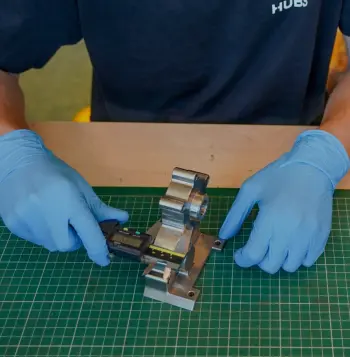
Brass is almost always CNC machined, and it is about as forgiving as metal gets. It cuts predictably, does not work-harden aggressively, produces short chips that clear easily instead of wrapping around the tool, and holds tolerances well. C360 on a modern lathe routinely holds tolerances of around plus or minus 0.01 millimetres, though achievable tolerances always depend on the specific part and geometry.
Turning is the most common process, since so many brass parts are round: bushings, fittings, valve stems and couplings. Milling handles brass with pockets, slots or more complex shapes, and the low cutting forces allow you to use small tools without them deflecting. As brass finishes so cleanly, parts often come off the machine ready to use, without the secondary polishing that other metals need.
It is important to remember that brass is relatively soft, so thin features and sharp edges can deform if the part is not clamped and tooled carefully. This is a setup consideration rather than a real limit on the material.
Get started
Not sure whether brass is the right choice for your part? Upload your CAD file for an instant quote and receive a free design analysis. You will see the cost and lead time for your material instantly.
Frequently asked questions
What is brass made of?
Brass mainly comprises copper and zinc. The copper gives corrosion resistance, conductivity and a warm color, while the zinc adds hardness and strength and lowers the melting point. Many grades also contain around 2–3% lead as a chip breaker.
What is the most machinable brass grade?
C360 (free-cutting brass) is the benchmark, rated 100 on the machinability index, with every other metal compared against it. Its European equivalent is Cz121 (CuZn39Pb3).
What is the difference between brass and bronze?
Both are copper alloys, but brass is copper and zinc while bronze is copper and tin. Brass is softer, cheaper and faster to machine, while bronze is harder and more wear-resistant, making it better suited for bearings and marine parts.
Is brass antibacterial?
Yes, brass is antibacterial. The copper in brass naturally kills bacteria on its surface, which is why it is often used for frequently touched parts like door handles and taps.