

Get instant quote

How to design interlocking joints for fastening 3D printed parts

Learn how to design interlocking joints for additive manufacturing, including finger, dovetail and puzzle joints, to assemble 3D printed parts in outsourced production.

How to design Interlocking Joints for fastening 3D Printed parts

Introduction

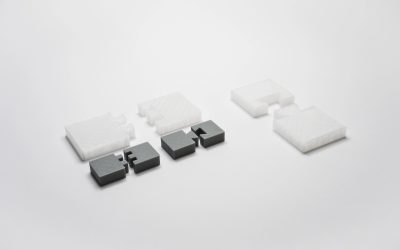
Interlocking joints are a practical method for engineers to connect components that will be assembled and disassembled repeatedly. They enable:

  • Fast assembly and disassembly

  • Reduced part count in an assembly

  • Joining multiple parts while avoiding process limits such as overhangs, bridges or support removal that can reduce print quality

  • Printing assemblies in multiple colors and materials

This article explains common applications of interlocking joints in 3D printing and recommends the 3D printing processes best suited to producing them.

3D printing technologies and interlocking joints

The table below summarizes common 3D printing technologies and their suitability for producing interlocking joints.

Process Description
FDM Low-cost, effective method for producing interlocking joints, but accuracy is lower than other 3D printing processes. ABS is preferred over PLA due to higher ductility.
SLA High accuracy, but parts can be brittle unless a tough resin is used.
SLS Well suited for interlocking parts, offering high print accuracy and good strength.
Material Jetting High strength and elasticity, combined with high-resolution detail, make material jetting ideal for interlocking joint applications.
Binder Jetting Not suitable for interlocking connections.

Designing for interlocking joints

There are three forces to consider when designing interlocking joints:

  • Friction: The primary force that holds the joint together. A tighter fit increases friction and makes the joint harder to separate.

  • Tension: The axial force that acts to pull the joint apart.

  • Shear: The transverse force perpendicular to tension that drives the joint to slide or tear sideways. 

Interlocking joints accuracy

When interlocking joints are manufactured in injection molding, a tolerance of 0.1mm is applied. For 3D printing, tolerances vary between technologies as summarized in the table below.

Process Interlocking parts tolerances
FDM 0.5 mm
SLA 0.2 mm
SLS 0.2 mm
Material Jetting 0.1 mm

Rules of thumb

  • SLS and material jetting are best suited for interlocking joints due to high print accuracy and material strength.

  • FDM is suitable for low-cost prototyping of interlocking connections when accuracy and durability are not critical.

  • Adding a small radius to part edges assists joint assembly and reduces stress concentrations.

Get a quote

Ready to print interlocking joints? Upload your design for an instant quote and process recommendations through Protolabs Network.
CNC machining, 3D printing and sheet metal fabrication parts
 

More resources for engineers

3D pritner software

Simulation software in additive manufacturing

Read article
Guide to plastics cover image

What materials have the best repeatability?

Read article
article-1million-image-1.png

Guide to designing for product scalability

Read article

What is GD&T? How to reduce manufacturing errors and improve quality

Read article

How do you design parts for MJF (Multi Jet Fusion) 3D printing?

Read article

What is design for manufacturability (DFM)?

Read article
3D Printing STL files: A step-by-step guide

3D printing STL files: A step-by-step guide

Read article
SLA 3D Printing materials compared

What’s the right resin for SLA? 3D printing materials compared

Read article
How to design parts for Binder Jetting 3D printing

How to design parts for binder jetting 3D printing

Read article
Aerospace 3D printing Applications

3D printing for aerospace and aviation

Read article
Understand and fix common STL file errors

What are the top STL file errors? Here's how to fix them

Read article
3D Modeling CAD Software

What is CAD modeling? Comparing design software for 3D printing

Read article
3D pritner software

Simulation software in additive manufacturing

Simulation software helps you predict exactly how designs will perform long before hitting the build plate. This article covers how this powerful digital tool can transform your workflows, slash prototyping costs, and get you to market ahead of the pack.

Read article
Guide to plastics cover image

What materials have the best repeatability?

Seeking consistency and predictability in your parts? Check out our guide on repeatability, which highlights the materials that will perform the same way time and time again.

Read article
article-1million-image-1.png

Guide to designing for product scalability

How can you create a part or product that’s ready to move from prototype to production? Check out our article, which offers tips and tricks for designing with scalability in mind.

Read article

What is GD&T? How to reduce manufacturing errors and improve quality

What is Geometric Dimensioning and Tolerancing (GD&T) and how is it used? This article explores the basics of how and when to use GD&T to get the best results out of custom part manufacturing.

Read article

How do you design parts for MJF (Multi Jet Fusion) 3D printing?

Multi Jet Fusion (MJF) 3D printing can create highly accurate, complex industrial parts more efficiently - and potentially more cost-effectively - than other industrial 3D printing processes. This article covers how to design parts for MJF, common applications of the technology and key best practices.

Read article

What is design for manufacturability (DFM)?

Design for manufacturing (DFM) means taking a design-first approach to manufacturing. In this article, we look at the overall DFM process, the necessary steps for a successful outcome, examples of DFM done right and how to get the most out of your own processes.

Read article
3D Printing STL files: A step-by-step guide

3D printing STL files: A step-by-step guide

Learn how to avoid low quality 3D prints or unnecessarily large files by exporting your STL file in the correct resolution.

Read article
SLA 3D Printing materials compared

What’s the right resin for SLA? 3D printing materials compared

What are the different materials available for SLA 3D printing? This article compares the main printing resins, including standard, tough, durable, heat resistant, rubber-like, dental and castable, by material properties. Find the best material option for your application.

Read article
How to design parts for Binder Jetting 3D printing

How to design parts for binder jetting 3D printing

A comprehensive guide on designing parts for Binder Jetting, covering the printing process, design specifications and material options.

Read article
Aerospace 3D printing Applications

3D printing for aerospace and aviation

How does industrial 3D printing accelerate development in aerospace and aviation? This overview explains how engineers use additive manufacturing for prototypes, tooling, and flight-ready components, and how outsourced production with a vetted supplier network reduces lead time and supports repeatable end-use part manufacturing.

Read article
Understand and fix common STL file errors

What are the top STL file errors? Here's how to fix them

What are the most common STL file errors and how will they affect your ability to export models for 3D printing? Learn to identify the errors you may encounter when working with STL files and how to fix them so they don't delay your next 3D printing run.

Read article
3D Modeling CAD Software

What is CAD modeling? Comparing design software for 3D printing

What is CAD modeling and why is it an essential tool for digital manufacturing? Explore the types of CAD software available for bringing ideas into the physical world via digital 3D modeling. Find the right software tools for your application.

Read article

Show more

Show less

Ready to transform your CAD file into a custom part? Upload your designs for a free, instant quote.

Get an instant quote