FDM
Fast & affordable prototyping
-
Dimensional accuracy of ± 0.5% with a lower limit: ± 0.5 mm
-
Lead times from 1 business day
Order production-ready MJF parts online with instant quoting, engineering-grade materials, and lead times from 3 business days. Our online MJF 3D printing service supports functional prototypes and end-use production parts.
Multi Jet Fusion (MJF) is an advanced 3D printing process that can speedily produce accurate, complex and detailed parts from powdered thermoplastics. MJF parts have high tensile strength and fine feature resolution, making them perfect for complex industrial parts. Developed by HP, this relatively new 3D printing technology is perfect for creating functional prototyping and production parts with isotropic mechanical properties, making it a go-to for any application requiring geometric complexity and impressive cosmetic and mechanical properties.
Learn more about MJF 3D printing

Our MJF printing service is ideal for both functional prototyping and end-use production. MJF creates parts with isotropic mechanical properties, meaning strength is distributed evenly in all directions. Combined with fast lead times, complex design freedom, and high-quality surface finishes, our online MJF printing service is well suited for applications in robotics, drones, consumer products, manufacturing tooling, and other demanding engineering environments.

| Maximum build size | Standard lead time | Dimensional accuracy | Layer height | Minimum feature size |
|---|---|---|---|---|
| 380 × 284 × 380 mm | From 3 business days | ± 0.3% with a lower limit of ± 0.3 mm (± 0.012 in) | 80μm | 0.5 mm |
Our new lightweight MJF service delivers production-ready parts with optimized performance and design freedom. Produce strong, lightweight parts with complex geometries, ideal for drones, robotics, and advanced engineering applications.

Leading companies across many industries use MJF for its industrial-grade materials
| Material | Color | Resolution | Tensile strength | Elongation at break | Heat deflection temperature | Application |
|---|---|---|---|---|---|---|
| HP PA 12 (Nylon 12) | Gray, dyed black | 80μm | 48 MPa | 15-20 % | 95-175 °C | Functional prototypes, complex assemblies, watertight applications |
| Glass-filled HP PA 12 (US only) | Gray | 80μm | 30 MPa | 6.5 % | 121-173 °C | Enclosures, housings, cases, fixtures, structural parts, tooling |
| HP PA11 (US only) | Gray, dyed black | 80µm | 52 MPa | 35-50 % | 54-185 °C | Functional prototypes and end-use parts; snap fits and living hinges, housings, enclosures, and fixtures |
| HP TPU 88A (US only) | Gray, dyed black | 100µm | 7-9 MPa | 150-280 % | 84-96 °C (Vicat softening temperature) | Functional prototypes and end-use parts; sporting products (e.g. shoe soles), orthopaedic models, protective cases, vibration dampening products, seals, gaskets, and grips |
One of the benefits of MJF 3D printing is how well part surfaces come out, especially after post-processing. Here are the surface finishes available for MJF.

Gray color, smooth surface, without visible layers, powder texture

Dyed black by immersion in a warm color bath. The color reaches a depth of about 0.5 mm on all surfaces.

The parts are placed in a tumbler of ceramic chips, creating a polished finish similar to injection molding.

Creates an even glossy finish across the outer layer of a part by exposing it to a solvent.
| Materials | Price | Dimensional accuracy | Strengths | Build volume | Layer thickness | Min. feature size | |
|---|---|---|---|---|---|---|---|
| FDM | 5 | $ | ± 0.5% with a lower limit on ± 0.5 mm | Low cost, wide range of materials | 500 x 500 x 500 mm (19.68" x 19.68" x 19.68") | 100-300μm | 2.0 mm (0.0787’') |
| Industrial FDM | 6 | $$$$ | ± 0.3% with a lower limit of ± 0.3 mm (± 0.012") | High level of repeatability, engineering grade materials | 406 x 355 x 406 mm (15.98” x 13.97” x 15.98") | 100-330μm | 2.0 mm (0.0787’') |
| Prototyping SLA | 8 | $$ | ± 0.3% with a lower limit of ± 0.3 mm (± 0.012") | Smooth surface finish, fine feature details | 145 × 145 × 175 mm (5.7" x 5.7" x 6.8") | 50-100μm | 0.2 mm (0.00787’') |
| Industrial SLA | 3 | $$$ | ± 0.2% with a lower limit of ± 0.13 mm (± 0.005") | Smooth surface finish, fine feature details, big print area | 500 x 500 x 500 mm (19.68" x 19.68" x 19.68") | 50-100μm | 0.2 mm (0.00787’') |
| SLS | 2 | $$ | ± 0.3% with a lower limit of ± 0.3 mm (± 0.012”) | Design flexibility, supports not required | 395 x 500 x 395 mm (15.53" x 19.68" x 15.53") | 100μm | 0.5 mm (0.0196”) |
| MJF | 2 | $$ | ± 0.3% with a lower limit on ± 0.3 mm (0.012’') | Design flexibility, supports not required | 380 x 285 x 380 mm (14.9’’ x 11.2’’ x 14.9’') | 80μm | 0.5 mm (0.0196”) |
The cost of an MJF printing service depends on your part geometry, material, quantity, and finishing requirements. Because MJF requires no tooling and can efficiently produce multiple parts in a single build, it is often a cost-effective solution for both prototyping and low-volume production.
Upload your CAD file to receive an instant quote and compare pricing across materials and finishing options.

We manufacture your custom parts according to strict manufacturing standards and ensure all parts and processes adhere to The Protolabs Network Standard. A thorough verification of these requirements is included in our inspection report that we ship with every order.
Bead blasting and air blasting are used to remove any remaining unfused powder.
To improve cosmetic appearance, additional post-processing can be applied, including dyeing, vapor smoothing and tumbling.


MJF is excellent for building strong parts, with maximum tensile strengths of XY and Z 48 MPa/6,960 psi with the ASTM D638 method.
MJF is ideal for producing parts with complex mechanical properties across all geometries.
MJF’s more robust automation capabilities reduce the need for most post-processing.
MJF provides quicker build speeds in comparison to other technologies, even with larger quantities of parts.

Printing with MJF will yield high-quality parts, though the cost may be considerably higher than with other technologies.
Limited materials available. HP may expand the range in the future.
This table summarizes the recommended and technically feasible values for the most common features of MJF 3D printed parts.
Learn more about how to design parts for MJF 3D printing
| Feature | Recommended size |
|---|---|
| Unsupported walls | 1.0 mm (0.040 in) |
| Supported walls | 0.7 mm (0.030 in) |
| Minimum detail size | 0.25 mm (0.010 in) |
| Minimum hole size | 1.0 mm (0.040 in) |
| Moving parts | 0.5 mm (0.020 in) |
| Assembly clearance | 0.4 mm (0.016 in) |
| Maximum wall thickness | 20 mm (0.8 in) |
Both MJF and SLS use powdered materials to create durable parts without support structures. MJF typically delivers faster production speeds, finer feature resolution, and more consistent surface quality, while SLS offers a broader range of materials. Both technologies are suitable for functional prototypes and end-use parts.
MJF pricing depends on part size, material, quantity, and finishing requirements. Because no tooling is required, MJF can be a cost-effective option for prototypes and low-volume production. Upload your CAD file to receive an instant quote and compare material and finishing options.
Our MJF printing service supports a range of engineering-grade materials, including HP PA 12 (Nylon 12), HP PA 11, glass-filled HP PA 12, and HP TPU 88A. Material availability may vary by region.
Standard lead times for our online MJF printing service start from 3 business days. Delivery times may vary depending on part complexity, order quantity, material selection, and finishing requirements.
MJF is widely used for end-use components thanks to its excellent mechanical properties, dimensional accuracy, and design flexibility. Common applications include robotics, industrial equipment, medical devices, consumer products, and production tooling.
Learn more about how our MJF printing service works and how to design the best parts for this groundbreaking additive manufacturing technology.
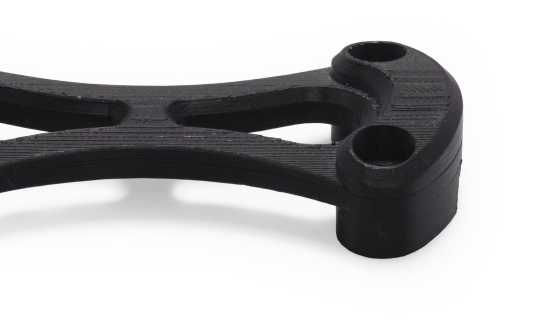
Fast & affordable prototyping
Dimensional accuracy of ± 0.5% with a lower limit: ± 0.5 mm
Lead times from 1 business day
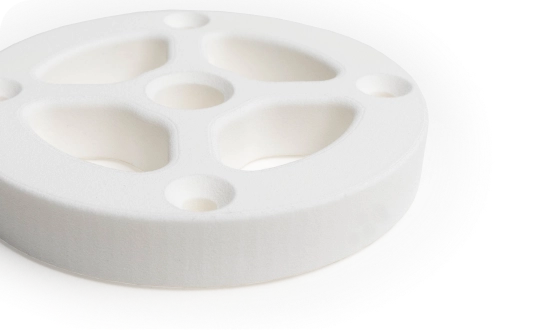
Functional prototyping & low-run production
Dimensional accuracy of ± 0.3% with a lower limit of ± 0.3 mm (± 0.012")
Lead times from 3 business days
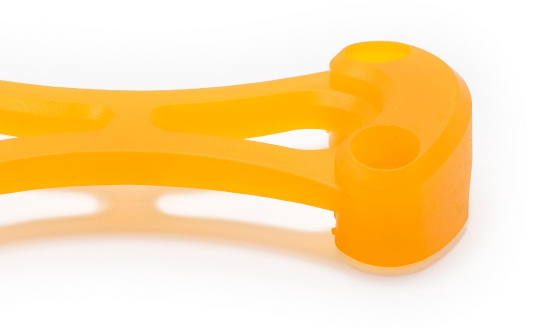
Visual prototyping
Dimensional accuracy of ± 0.3% with a lower limit of ± 0.3 mm (± 0.012")
See our SLA services